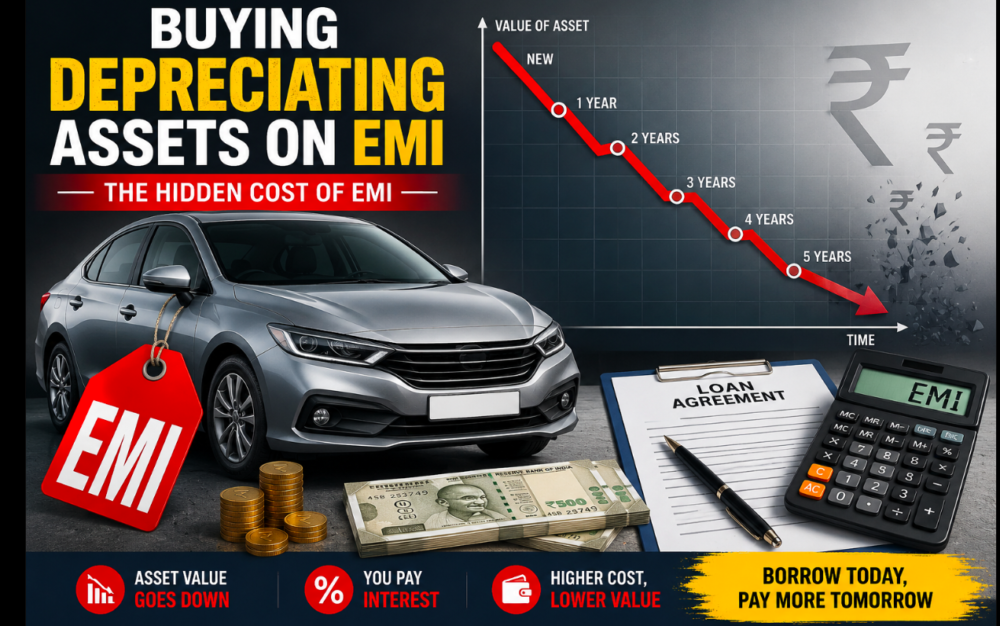
Buying something expensive through EMI can make it feel affordable. Instead of paying ₹10 lakh upfront, you might pay a few thousand rupees every month.
But there is an important question many buyers overlook:
What happens when you are still paying the EMI, but the thing you purchased is already losing value?
This is where buying a depreciating asset on EMI can become financially challenging.Buying Depreciating Assets on EMI: Why It Can Hurt Your Finances
Cars, motorcycles, smartphones, laptops, furniture and many other consumer products generally lose value over time. When you finance these purchases with a loan, you may end up paying interest on an asset whose resale value is continuously declining.
That does not mean every EMI purchase is a bad financial decision. The impact depends on the asset, loan interest rate, tenure, income, usage and your overall financial situation.Buying Depreciating Assets on EMI: Why It Can Hurt Your Finances
Buying Depreciating Assets on EMI: Why It Can Hurt Your Finances
What Is a Depreciating Asset?
A depreciating asset is something that generally loses monetary value as it gets older or is used.
Common examples include:
- Cars
- Motorcycles and scooters
- Smartphones
- Laptops
- Televisions
- Furniture
- Consumer electronics
- Some types of machinery
For example, suppose you purchase a car for ₹12 lakh.
After several years, you may not be able to sell it for ₹12 lakh. Its market value could be significantly lower because of age, mileage, condition and changes in consumer demand.
At the same time, if you purchased the car using a loan, you are paying both:
1. The cost of the asset
2. The cost of borrowing money
This combination is what makes financing depreciating assets worth examining carefully.
Why Buying Depreciating Assets on EMI Can Be Negative
1. You Pay Interest While the Asset Loses Value
This is the biggest problem.
Imagine you purchase a car for ₹10 lakh and finance ₹8 lakh through a five-year loan.
Your car starts depreciating from the time you own it, while your loan continues to generate interest according to its repayment schedule.
So you could have a situation where:
Asset value ↓
while
Loan repayment continues →
You are therefore paying for something that is becoming less valuable.
2. EMI Makes Expensive Purchases Feel Affordable
One psychological problem with EMI is that consumers often focus on the monthly payment rather than the total cost.
For example:
Cash price: ₹10 lakh
Instead of thinking:
“Can I comfortably afford a ₹10 lakh car?”
you may think:
“Can I afford an EMI of ₹20,000 per month?”
These are two very different questions.
A low monthly EMI does not necessarily mean the purchase is affordable.
A longer loan tenure can reduce the monthly EMI while increasing the total interest paid.
Therefore, always consider:
Down payment + total interest + fees + maintenance + depreciation = real cost of ownership
3. Long Loan Tenures Can Increase the Problem
A longer tenure generally reduces the monthly EMI but increases the period over which interest is paid.
For example, consider a hypothetical ₹8 lakh loan:
| Loan Tenure | Monthly EMI | Total Interest |
|---|---|---|
| 3 years | Higher | Lower |
| 5 years | Moderate | Higher |
| 7 years | Lower | Higher still |
The exact EMI and interest will depend on the interest rate and lender.
The important point is that monthly affordability and total affordability are not the same thing.
Before choosing an EMI, calculate the total amount you will repay over the entire loan.
4. You Can End Up With Negative Equity
One of the more serious situations occurs when the outstanding loan becomes larger than the resale value of the asset.
Suppose:
Outstanding loan: ₹7 lakh
Current resale value: ₹5.5 lakh
You effectively have a ₹1.5 lakh gap.
If you want to sell the asset and close the loan, you may need to arrange additional money.
This situation can be particularly uncomfortable when someone wants to upgrade to another vehicle while the existing loan is still outstanding.
5. EMI Reduces Your Monthly Cash Flow
An EMI is a fixed financial commitment.
Once you take a loan, part of your future income is already committed to repayment.
For example:
Monthly income = ₹80,000
Existing expenses = ₹40,000
New EMI = ₹20,000
The remaining amount for savings, investments, emergencies and unexpected expenses becomes much smaller.
This can make it harder to:
- Build an emergency fund
- Invest regularly
- Save for a house
- Handle unexpected expenses
- Pay off other debt
- Reach long-term financial goals
The problem isn’t necessarily the asset itself. The problem is how much of your future income is being committed to it.
6. Depreciation Doesn’t Stop When the EMI Ends
Imagine you purchase a car using a five-year loan.
After five years:
Loan balance: ₹0
But the car has also aged five years.
Its value may now be significantly lower than the original purchase price.
This means paying off the loan does not restore the money you spent.
The EMI was simply the method used to finance the purchase.
The asset’s depreciation continues regardless of whether you paid cash or borrowed money.
EMI vs Cash: Which Is Better?
There is no universal answer.
Paying cash can make sense when:
- You have sufficient savings
- Your emergency fund remains intact
- You don’t have expensive existing debt
- The purchase is genuinely necessary
- Paying cash does not disrupt your investment goals
EMI can make sense when:
- Paying cash would significantly reduce your emergency reserves
- The loan interest rate is reasonable
- Your income is stable
- The EMI comfortably fits your budget
- The asset provides meaningful utility
- You have a clear long-term plan for the asset
Therefore, “EMI is bad” is too simplistic.
The better question is:
“Is this EMI financially sustainable for me?”
When Buying a Depreciating Asset on EMI May Make Sense
Not every depreciating asset is a bad purchase.
For example, a car may lose value but provide substantial utility.
It could help someone:
- Commute to work
- Travel with family
- Run a business
- Transport goods
- Save significant commuting time
In such cases, the financial decision should consider the utility and benefits of the asset, not just its resale value.
A depreciating asset can still be worth buying if it provides enough value relative to its total cost.
When You Should Be More Careful
Buying a depreciating asset on EMI becomes more concerning when:
- The EMI consumes a large portion of your income
- You have little or no emergency savings
- You already have multiple loans
- You are extending the loan mainly to reduce the EMI
- You are buying something primarily for status
- You frequently upgrade the asset
- The asset loses value quickly
- You have high-interest debt already
- The purchase prevents you from investing or saving
A useful principle is:
Don’t judge affordability only by whether you can pay the EMI. Judge it by whether you can comfortably handle the entire financial commitment.
Example: ₹12 Lakh Car on EMI
Consider a hypothetical example.
Car price = ₹12 lakh
Down payment = ₹3 lakh
Loan = ₹9 lakh
Assume the loan has an interest rate of 9% and a five-year tenure.
You will repay more than the ₹9 lakh principal because of interest.
At the same time, the car will generally depreciate during those five years.
So your financial equation becomes:
Purchase price + loan interest + insurance + maintenance + fuel − resale value = effective ownership cost
This is a much better way to evaluate a vehicle than looking only at the EMI.
The Opportunity Cost of EMI
There is another factor that people often ignore: opportunity cost.
Money used to pay an EMI cannot simultaneously be used for another financial purpose.
For example, a large monthly EMI could reduce the amount available for:
- Mutual fund investments
- Retirement savings
- Emergency funds
- Education planning
- Home down payment
- Business investment
This does not automatically mean investing is better than repaying a loan. Investment returns are uncertain, while loan interest is a contractual cost.
The correct comparison should consider the after-tax, risk-adjusted expected return versus the effective cost of borrowing.
A Better Way to Decide Before Taking an EMI
Before buying a depreciating asset, ask yourself these questions:
1. Do I actually need it?
Separate a genuine need from an upgrade or impulse purchase.
2. What is the total cost?
Don’t look only at the EMI.
Calculate:
Down payment + total EMI payments + fees + maintenance + insurance − expected resale value
3. How much interest will I pay?
Ask the lender for the total repayment amount.
4. What happens if my income falls?
Could you continue paying the EMI for several months?
5. Will the EMI reduce my investments?
If the purchase prevents you from saving consistently, reconsider the purchase price.
6. How long will I keep the asset?
Keeping a vehicle for many years can change the economics compared with replacing it every few years.
7. Could I buy a cheaper alternative?
Consider:
- Used vehicles
- Lower variants
- Previous-generation models
- Refurbished electronics
- Delaying the purchase
Sometimes the best financial decision is simply buying a less expensive version.
Depreciating Asset + EMI: The Real Problem
The biggest issue isn’t simply:
“Depreciating asset = bad.”
The bigger problem is:
“Borrowing too much money to purchase something that loses value while sacrificing future cash flow.”
Debt can be useful when it is affordable and serves a clear purpose.
But when consumer debt is used to purchase expensive depreciating assets beyond your financial capacity, it can slow down wealth creation.
Final Takeaway
Buying a depreciating asset on EMI is not automatically a financial mistake.
However, it can become expensive when you combine:
High purchase price + high-interest loan + long tenure + rapid depreciation + high maintenance costs + limited income
Before taking an EMI, look beyond the monthly payment.
Calculate the total borrowing cost, depreciation, ownership expenses and impact on your future savings.
The goal should not be to avoid every EMI.
The goal should be to make sure your EMI does not prevent you from building financial security and long-term wealth.
Remember: An affordable EMI is not necessarily an affordable purchase.
Frequently Asked Questions
Is buying a car on EMI a bad financial decision?
Not necessarily. It depends on the car’s price, loan cost, tenure, income, savings and how useful the vehicle is to you.
Why are depreciating assets risky on EMI?
Because you pay interest on the borrowed money while the asset may simultaneously lose market value.
Is it better to buy a car with cash or EMI?
There is no universal answer. Paying cash can reduce interest costs, while EMI can preserve liquidity. Compare the total loan cost with the opportunity cost of using your savings.
Should I take a long-tenure EMI to reduce my monthly payment?
A longer tenure can lower the monthly EMI but may increase the total interest paid. Compare total repayment before choosing the tenure.
Are all EMIs bad?
No. EMI is simply a financing method. Whether it is financially sensible depends on the cost of borrowing, the purchase and your ability to comfortably repay it.
What is the biggest mistake when buying depreciating assets?
Focusing only on the monthly EMI instead of calculating the total cost of ownership and understanding how the purchase affects future savings and investments.