The Dollar Index (DXY) remains an important indicator for traders and investors tracking the strength of the US dollar against a basket of major currencies. The index is influenced by US interest rates, Federal Reserve policy, inflation, Treasury yields, economic growth and global geopolitical developments.Dollar Index Price Prediction 2026
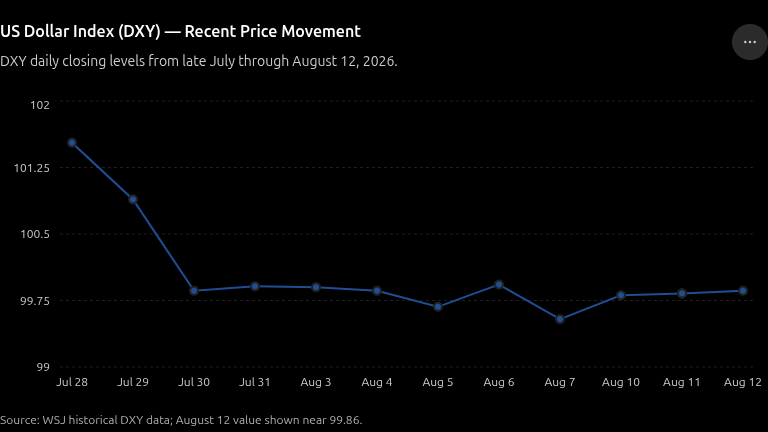
As of August 2026, DXY is trading around the 99–100 area, with markets closely watching US inflation data, Federal Reserve policy expectations and geopolitical developments. Recent market reports have highlighted the potential for increased dollar volatility around US economic data and changing interest-rate expectations.Dollar Index Price Prediction 2026
Dollar Index Price Prediction 2026
The outlook for the Dollar Index in 2026 remains highly dependent on the direction of US monetary policy and the relative performance of the US economy.
A sustained move above the 100–101 zone could strengthen the bullish technical outlook, while a failure to hold important support levels could bring renewed selling pressure.
Recent technical analysis has identified the 99–100.6 area as an important resistance zone, with a sustained break above 100.6 potentially opening the way toward the 102 region. Earlier technical analysis also identified support around 97.50–98.00.
Possible DXY scenarios for 2026
| Scenario | Potential DXY zone | What could drive it? |
|---|---|---|
| Bullish | 101–103+ | Higher US yields, stronger economic data, Fed staying restrictive |
| Neutral | 97–101 | Mixed economic data and range-bound monetary policy |
| Bearish | 94–97 | Faster rate cuts, weaker US growth and declining Treasury yields |
These are scenario ranges rather than guaranteed price targets.
What Could Influence the Dollar Index?
1. Federal Reserve interest rates
Federal Reserve policy is one of the biggest drivers of the Dollar Index.
If the Fed maintains higher interest rates for longer than other major central banks, US assets can become relatively attractive, potentially supporting the dollar.
On the other hand, expectations for faster rate cuts can put downward pressure on DXY.tradecol
2. US inflation
Inflation data is particularly important because it can influence expectations for future Federal Reserve decisions.
Higher-than-expected inflation could increase expectations for tighter monetary policy and potentially support DXY. Lower inflation could have the opposite effect.
Markets are currently watching US inflation closely because it can influence expectations surrounding the Fed’s September policy decision.
3. US Treasury yields
Dollar strength is also closely connected to US Treasury yields.
Rising yields can make dollar-denominated assets more attractive, while falling yields can reduce the relative appeal of the US dollar.
4. Geopolitical risk
The US dollar can benefit from safe-haven demand during periods of significant geopolitical uncertainty.
Recent tensions surrounding the Middle East and the Strait of Hormuz have contributed to changes in oil prices, Treasury yields and expectations for US monetary policy, creating additional volatility for DXY.
DXY Technical Outlook
From a technical perspective, the 100 level is an important psychological area for the Dollar Index.
A sustained move above the 100.6 resistance area could indicate improving bullish momentum, with 102 becoming a potential next resistance area according to previous technical analysis.
On the downside, the 97.50–98 region has previously acted as an important support zone.
Therefore, traders may watch the following levels:
- Resistance: 100–100.6
- Higher resistance: 101–102
- Support: 97.5–98
- Major psychological level: 100
Is the Dollar Index Bullish or Bearish?
The answer depends on the timeframe.
In the short term, DXY can remain supported if US economic data and Treasury yields remain strong. However, the medium- to long-term outlook is more uncertain because monetary-policy expectations and structural concerns surrounding the US dollar can create downside risks.
For example, PwC’s 2026 outlook previously projected further dollar weakness during 2026, while other market analysis has focused on the possibility of a recovery if US economic conditions and interest-rate expectations become more supportive.
Dollar Index Price Prediction: What Should Traders Watch?
Before making a directional prediction, traders should monitor:
- US CPI and inflation data
- Federal Reserve interest-rate decisions
- US Treasury yields
- US employment data
- US GDP and economic activity
- EUR/USD movements
- Oil prices
- Global geopolitical risk
- US economic growth compared with Europe and other major economies
Because the euro has a large weighting in the Dollar Index, major moves in EUR/USD can have a significant impact on DXY.
Dollar Index Forecast: Bullish Case
The bullish case for DXY would become stronger if:
- US economic data remains resilient.
- Inflation remains elevated.
- The Fed keeps rates higher for longer.
- US Treasury yields rise.
- Geopolitical uncertainty increases demand for safe-haven assets.
- DXY breaks and holds above the 100–100.6 resistance zone.
Under this scenario, the 101–102 area could become an important upside region.
Dollar Index Forecast: Bearish Case
The bearish case would strengthen if:
- US inflation falls substantially.
- The Federal Reserve becomes more dovish.
- US Treasury yields decline.
- US economic growth weakens.
- Other major economies outperform the US.
- DXY loses the 97.5–98 support region.
A decisive break below major support could increase the probability of a deeper correction.
Final Outlook
The Dollar Index price prediction for 2026 remains highly dependent on Federal Reserve policy, inflation, Treasury yields and global risk sentiment.
For traders, the 100–100.6 resistance zone and 97.5–98 support zone are important areas to monitor. A sustained breakout above resistance could improve the bullish outlook, while a breakdown below support could signal renewed dollar weakness.
However, DXY forecasts should be treated as scenarios rather than certainties. Economic data and central-bank expectations can change rapidly, so traders should combine fundamental analysis with technical indicators and appropriate risk management.
Disclaimer: This article is for educational and informational purposes only and should not be considered financial or investment advice. Currency and index markets can be highly volatile, and past performance does not guarantee future results.