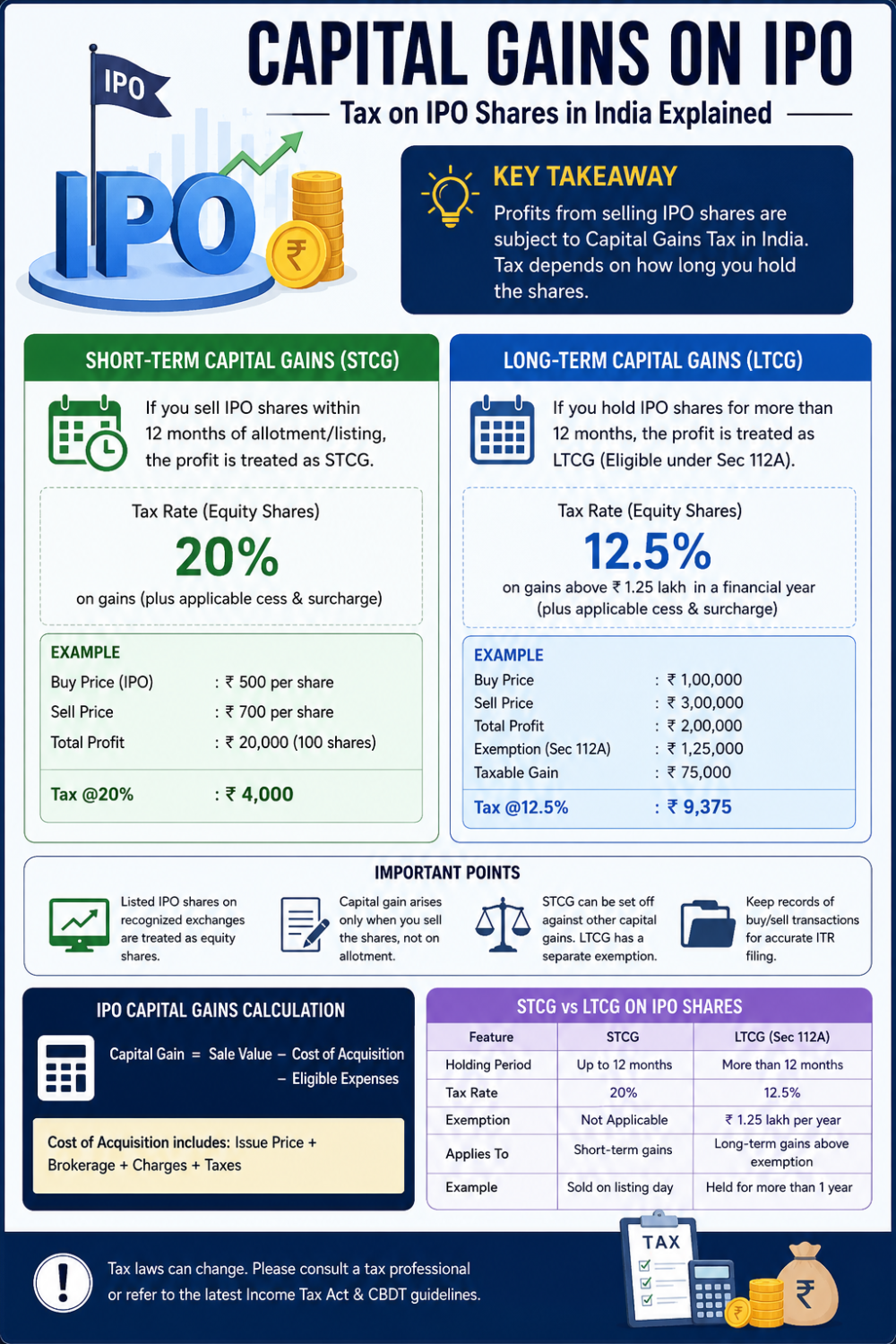
Investing in an Initial Public Offering (IPO) can provide investors with an opportunity to participate in a company’s stock market listing. However, if you sell IPO shares at a profit, the gain may be subject to capital gains tax in India.Capital Gains on IPO: Tax on IPO Shares in India Explained
The tax treatment generally depends on how long you hold the shares after listing. IPO shares listed on a recognised stock exchange are generally subject to the same capital-gains framework as other listed equity shares.Capital Gains on IPO: Tax on IPO Shares in India Explained
What Are Capital Gains on IPO Shares?
Capital gain is the profit earned when you sell your IPO shares for more than their cost.
For example, suppose you receive 100 IPO shares at an issue price of ₹500 per share and later sell them at ₹700 per share.
Purchase cost: ₹50,000
Sale value: ₹70,000
Capital gain: ₹20,000
The applicable tax depends largely on the holding period and the applicable equity capital-gains rules.
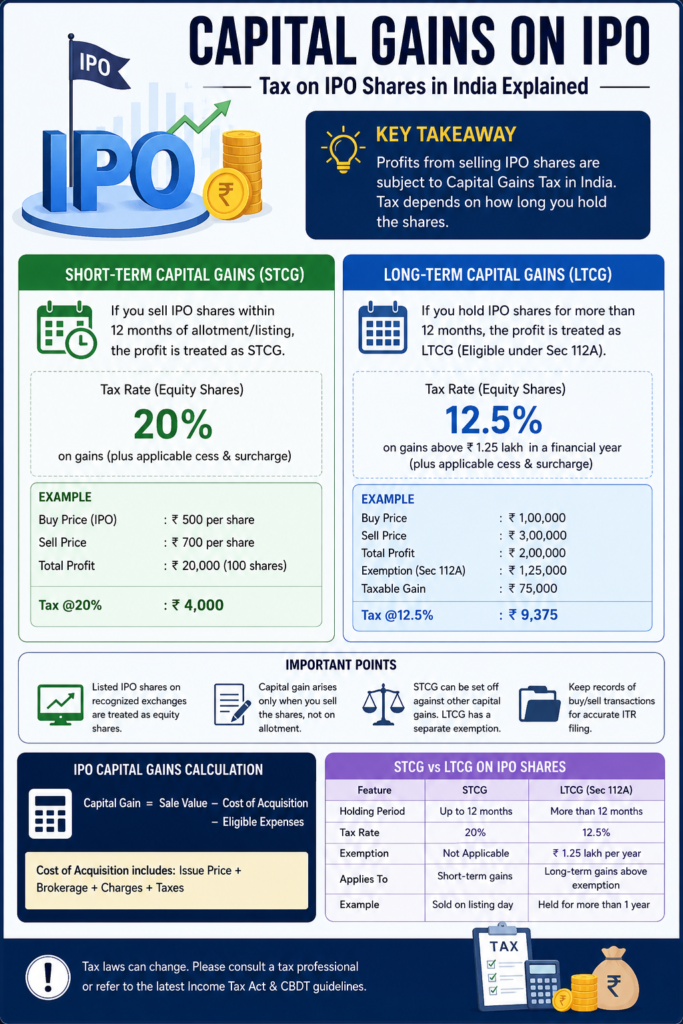
Short-Term Capital Gains (STCG) on IPO Shares
If you sell listed IPO shares within the applicable short-term holding period, the gain can be classified as Short-Term Capital Gain (STCG).
For listed equity shares on which Securities Transaction Tax (STT) conditions are satisfied, the applicable STCG tax rate is currently 20% for transfers covered by the post-23 July 2024 regime.
Example of STCG on IPO
Suppose:
- IPO allotment price = ₹500
- Shares allotted = 100
- Selling price = ₹700
- Total profit = ₹20,000
If the gain qualifies as STCG, tax at 20% would be:
₹20,000 × 20% = ₹4,000
Additional applicable surcharge and health and education cess may also affect the final tax liability.
Long-Term Capital Gains (LTCG) on IPO Shares
If you hold listed equity shares for more than the applicable long-term holding period, the resulting gain can qualify as Long-Term Capital Gain (LTCG).tradecol
For eligible listed equity shares covered under Section 112A, LTCG exceeding the applicable annual exemption threshold is currently taxed at 12.5%.
The annual exemption threshold for eligible Section 112A gains is currently ₹1.25 lakh.
Example of LTCG on IPO
Suppose you purchase IPO shares for ₹1,00,000 and eventually sell them for ₹3,00,000.
Capital gain = ₹2,00,000
If the entire gain qualifies under Section 112A, the amount exceeding the ₹1.25 lakh exemption threshold would be:
₹2,00,000 − ₹1,25,000 = ₹75,000
Tax at 12.5%:
₹75,000 × 12.5% = ₹9,375
Cess and other applicable provisions can affect the final amount payable.
Is IPO Profit Taxable?
Yes. IPO profits can be taxable when the shares are sold at a profit.
Simply receiving an IPO allotment does not normally create a capital gain. The capital gain generally arises when the shares are transferred or sold.
For example:
IPO allotment → No capital gain merely from allotment
IPO shares sold above cost → Capital gain may arise
What Happens If You Sell IPO Shares on Listing Day?
If you sell your IPO shares on the listing day for a price higher than your acquisition cost, the resulting profit is generally treated as a short-term capital gain, assuming the transaction meets the relevant conditions.
For example:
IPO issue price = ₹500
Listing-day selling price = ₹800
Gain per share = ₹300
For 100 shares:
Total gain = ₹30,000
The applicable STCG rules would generally apply.
IPO Capital Gains Calculation
A simple calculation is:
Capital Gain = Sale Value − Cost of Acquisition − Eligible Transfer Expenses
For IPO shares, the cost of acquisition generally includes the amount paid to acquire the shares.
Investors should also account for applicable brokerage, transaction charges and other eligible expenses when calculating taxable gains, subject to tax rules.
STCG vs LTCG on IPO Shares
| Feature | STCG | LTCG |
|---|---|---|
| Holding period | Short-term | Long-term |
| Eligible listed equity rate* | 20% | 12.5% |
| LTCG exemption | Not applicable | ₹1.25 lakh annually under Section 112A |
| Listing-day sale | Generally STCG | Not applicable |
| Tax applies to | Eligible short-term gains | Eligible long-term gains above exemption |
*Rates are based on the current post-23 July 2024 framework and can change with future tax legislation.
Does IPO Allotment Date Matter for Holding Period?
Yes. The holding period is important when determining whether the shares qualify as short-term or long-term.
Investors should maintain records showing the relevant acquisition date, cost of acquisition and sale date.
How to Reduce Tax on IPO Capital Gains?
Tax planning should be based on the applicable tax rules rather than simply trying to avoid tax.
Investors can consider:
- Understanding the STCG and LTCG rules before selling.
- Tracking gains and losses from other equity investments.
- Considering eligible capital-loss set-off provisions.
- Maintaining accurate purchase and sale records.
- Reviewing the annual LTCG exemption available under the applicable rules.
- Consulting a qualified tax professional for large transactions.
Final Takeaway
Capital gains on IPO shares depend mainly on the sale price, acquisition cost, holding period and applicable tax provisions.
Selling IPO shares shortly after listing can result in short-term capital gains, while holding eligible listed equity shares beyond the applicable long-term period can result in long-term capital gains.
Because tax rules can change, investors should verify the applicable rates and exemptions for the financial year in which the shares are sold before filing their tax return.