Introduction
Technology is evolving faster than ever, with artificial intelligence, robotics, quantum computing, semiconductors and advanced connectivity moving from research labs toward real-world applications.
The upcoming technology trends in 2026 could have a significant impact on businesses, consumers and the global economy. Some technologies are already being adopted, while others are still in their early development stages.Quantum Computing will be Upcoming Technology Trends in
For investors and technology enthusiasts, understanding these emerging technologies in 2026 can help identify industries that could experience strong growth over the coming years.
Here are 10 major technology trends worth watching.Quantum Computing will be Upcoming Technology Trends.
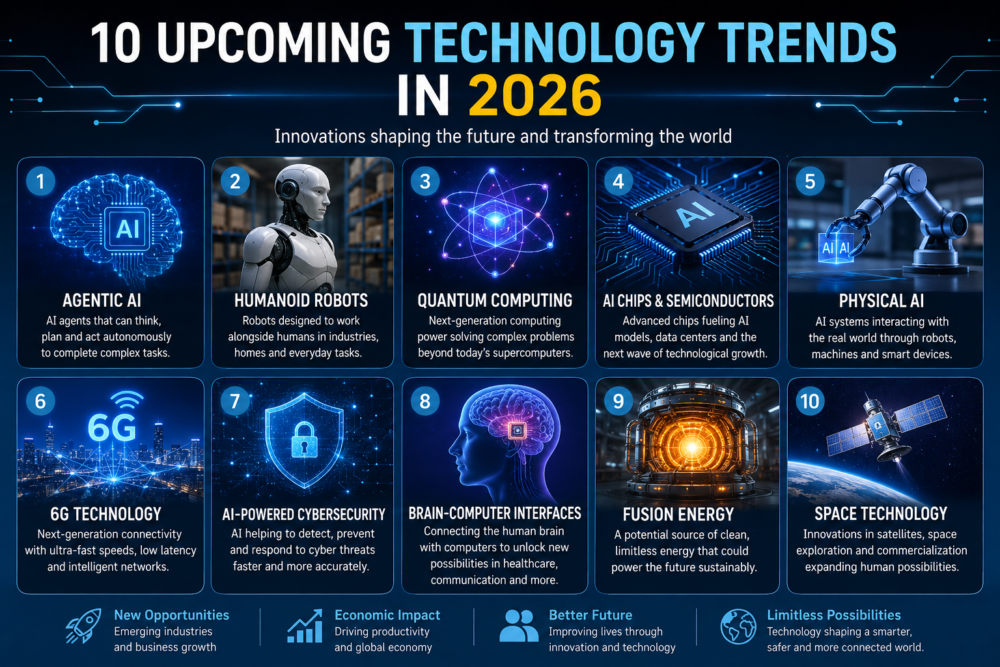
1. Agentic AI
Artificial intelligence is moving beyond simple chatbots and content generation.
Agentic AI refers to AI systems that can understand objectives, plan tasks and take actions with limited human intervention.
Instead of simply answering a question, an AI agent could potentially research information, analyze data, interact with software and complete a series of tasks automatically.
Why Agentic AI Matters
Businesses could use AI agents for:
- Customer support
- Marketing
- Software development
- Data analysis
- Financial research
- Administrative tasks
- Business automation
As AI becomes more autonomous, agentic AI could become one of the most important future technology trends.
2. Humanoid Robots
Humanoid robots are another emerging technology attracting significant attention.
These robots are designed to operate in environments created for humans, including factories, warehouses and potentially homes.
Advances in AI, computer vision, sensors and robotics are helping machines understand and interact with their surroundings more effectively.Quantum Computing will be Upcoming Technology Trends in
Potential Applications
Humanoid robots could eventually be used in:
- Manufacturing
- Warehousing
- Logistics
- Healthcare
- Agriculture
- Retail
- Domestic environments
The combination of AI and robotics could create an entirely new technology industry.
3. Quantum Computing
Quantum computing is one of the most closely watched areas of advanced technology.
Traditional computers use bits, while quantum computers use quantum bits, or quoits, to process information in fundamentally different ways.
Quantum computing could eventually have applications in areas such as:
- Drug discovery
- Financial modelling
- Cryptography
- Logistics
- Materials science
- Scientific research
However, quantum computing remains an emerging technology and faces significant technical challenges before widespread commercial adoption.
4. AI Chips and Advanced Semiconductors
The rapid growth of artificial intelligence is increasing demand for powerful computing hardware.
AI models require specialized processors capable of handling huge amounts of data. This has increased interest in GPUs, AI accelerators and advanced semiconductor manufacturing.
Why AI Chips Are Important
AI infrastructure requires:
- High-performance processors
- Advanced memory
- Semiconductor manufacturing
- High-speed networking
- Data-center infrastructure
As AI adoption grows, the semiconductor industry could remain an important part of the technology ecosystem.
5. Physical AI
One of the most interesting developments is the movement of AI from digital environments into the physical world.
This concept is often referred to as Physical AI.
Physical AI combines artificial intelligence with machines such as:
- Robots
- Autonomous vehicles
- Industrial machines
- Drones
- Smart manufacturing systems
Instead of AI simply generating text or images, physical AI allows intelligent systems to perceive their environment and interact with it.
6. 6G Technology
While 5G networks continue expanding, researchers and technology companies are already working toward 6G technology.
6G is expected to focus on extremely high-speed connectivity, lower latency and intelligent network infrastructure.
Potential applications could include:
- Advanced robotics
- Autonomous transportation
- Smart cities
- Immersive communication
- Industrial automation
- AI-powered devices
The commercial rollout of 6G is still years away, but developments during the next several years could shape the future of connectivity.
7. AI-Powered Cybersecurity
As companies increasingly depend on digital systems, cybersecurity is becoming more important.
At the same time, artificial intelligence is changing both sides of the cybersecurity landscape.
AI can potentially help organizations detect unusual behavior, identify threats and respond to security incidents faster.
However, attackers can also use AI to develop more sophisticated attacks.
This means AI cybersecurity could become a major technology market in the coming years.
8. Brain-Computer Interfaces
Brain-computer interfaces, commonly known as BCIs, are another futuristic technology attracting attention.
BCIs aim to create a communication pathway between the brain and external computing systems.
Potential applications include:
- Medical research
- Assistive technologies
- Communication systems
- Neurotechnology
- Human-computer interaction
Although the technology is still developing, successful advances could fundamentally change how humans interact with computers.
9. Fusion Energy
Fusion energy could potentially provide a new source of low-carbon energy.tradecol
Unlike conventional nuclear fission, fusion attempts to replicate the process that powers stars by combining atomic nuclei under extreme conditions.
If researchers can develop commercially viable fusion power plants, the technology could have major implications for:
- Electricity generation
- Energy security
- Industrial production
- Data centers
- Artificial intelligence infrastructure
Fusion remains a long-term technology opportunity rather than an established commercial energy source.
10. Space Technology
Space technology is also becoming an increasingly important area of innovation.
Modern space companies are working on reusable launch systems, satellite networks, Earth observation and other technologies.
Potential growth areas include:
- Satellite internet
- Earth observation
- Space communications
- Reusable rockets
- Space-based infrastructure
- Commercial space services
As launch costs decrease and private investment increases, the space economy could become an important technology sector.
Which Technology Could Have the Biggest Impact?
There may not be one single technology that dominates the future.
Instead, the biggest transformation could come from the combination of multiple technologies.
For example:
AI + Robotics = Intelligent Machines
AI + Semiconductors = Advanced Computing
AI + Quantum Computing = Next-Generation Computing
AI + Cybersecurity = Automated Threat Detection
AI + Space Technology = Intelligent Space Infrastructure
This technological convergence could create new industries and business models.
Technology Trends and Investment Opportunities
Emerging technologies can create opportunities, but they also involve significant uncertainty.
Investors should consider factors such as:
- Technology maturity
- Revenue growth
- Competition
- Government regulation
- Research and development costs
- Market demand
- Company valuation
A promising technology does not automatically mean every company operating in that sector will succeed.
Therefore, investors should conduct their own research and consider risk before making investment decisions.
Frequently Asked Questions
What are the biggest upcoming technology trends in 2026?
Some of the major technology trends include agentic AI, humanoid robots, quantum computing, AI chips, physical AI, cybersecurity, 6G and space technology.
What is the next big technology after AI?
Robotics, agentic AI, quantum computing and physical AI are among the technologies that could become major areas of innovation after the current generative AI boom.
Is quantum computing the future?
Quantum computing has significant long-term potential, particularly in scientific research, cryptography, optimization and drug discovery. However, widespread commercial adoption is still developing.
What is physical AI?
Physical AI refers to artificial intelligence systems that interact with and operate in the physical world through robots, autonomous machines, vehicles and other devices.
Which technology sectors could grow in the future?
AI infrastructure, semiconductors, robotics, cybersecurity, quantum computing, energy technology and space technology are potential areas of long-term growth.
Conclusion
The upcoming technology trends in 2026 demonstrate how quickly the technology landscape is changing.
Artificial intelligence is no longer developing in isolation. It is increasingly being combined with robotics, semiconductors, cybersecurity, quantum computing, energy and space technology.
For businesses and investors, understanding these emerging technologies can help identify where future innovation may occur.
However, emerging technology also comes with uncertainty and risk. The technologies that receive the most attention today may not necessarily become the biggest commercial successes tomorrow.
The next decade could therefore be less about one revolutionary technology and more about different technologies working together to create entirely new industries.
Disclaimer: This article is for educational and informational purposes only and should not be considered financial or investment advice.