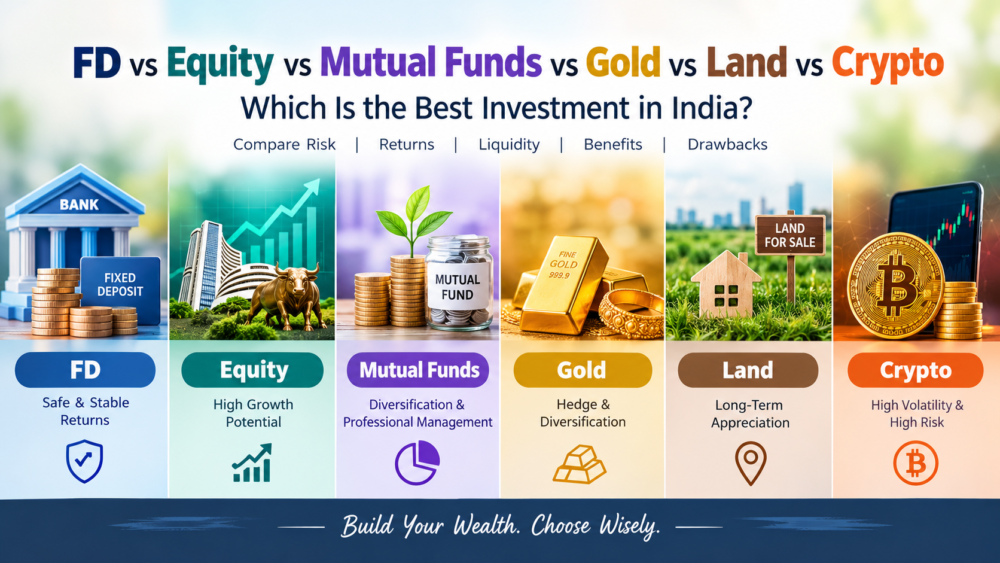
Best Investment hopes in India for 2027 makes you Richer?
Choosing the right investment option is an important step toward building long-term wealth. In India, investors have several choices, including Fixed Deposits (FDs), equity shares, mutual funds, gold, land and cryptocurrency. Each investment option offers different levels of risk, potential returns, liquidity and suitability for financial goals.Best Investment hopes in India for 2027 will make you Richer?
Best Investment hopes in India for 2027 makes you Richer?
The answer depends on your investment horizon, risk tolerance, financial goals and need for liquidity. While FDs are generally preferred for predictable returns, equity and equity mutual funds offer long-term growth potential. Gold can help diversify a portfolio, land however long-term appreciation, and cryptocurrency carries substantial volatility and regulatory risks. like tradecol
In this guide, we compare these six investment options to help Indian investors understand their advantages, disadvantages and key differences before investing.Best Investment hopes in India for 2027 will make you Richer?
Quick Comparison: FD vs Equity vs Mutual Funds vs Gold vs Land vs Crypto
| Investment option | Risk level | Return potential | Liquidity | Generally suitable for |
|---|---|---|---|---|
| Fixed Deposit (FD) | Low, subject to issuer and deposit limits | Predictable interest | Moderate | Capital stability and planned expenses |
| Equity shares | High | High, but uncertain | Generally high for actively traded shares | Long-term growth |
| Mutual funds | Low to very high, depending on the fund | Depends on the underlying assets | Varies by scheme | Diversification and goal-based investing |
| Gold | Moderate to high | Market-dependent | Generally good for market-traded forms | Diversification and potential inflation hedge |
| Land | Moderate to high | Location-dependent | Low | Long-term investors with sufficient capital |
| Cryptocurrency | Very high | Highly uncertain | Varies by asset and platform | Investors who can tolerate substantial losses |
These are general comparisons, not guarantees. Actual risk, returns, costs and liquidity vary by product, market conditions and investment period.
1. What Is a Fixed Deposit (FD)?
A Fixed Deposit is a financial product in which you deposit money with a bank or eligible financial institution for a specified period at an agreed interest rate. Depending on the FD terms, interest may be paid periodically or accumulated until maturity.
Advantages of Fixed Deposits
- Predictable returns: The interest rate is generally fixed for the agreed tenure.
- Capital stability: Bank FDs are generally less volatile than market-linked investments.
- Flexible tenures: Investors can choose from different available maturity periods.
- Simple to understand: FDs are suitable for people who prefer predictable interest income.
Disadvantages of Fixed Deposits
- Returns may not keep pace with inflation after tax.
- Premature withdrawals may attract penalties or reduced interest.
- Interest income is generally taxable according to applicable income-tax rules.
- Deposits with a particular bank are subject to credit risk and applicable deposit-insurance limits.
Who Should Invest in FDs?
FDs may suit conservative investors, people saving for short-term goals and those who want predictable interest income. They can also serve as part of an emergency fund, alongside readily accessible savings.
However, an FD may not be sufficient on its own for long-term wealth creation, especially when inflation reduces purchasing power.
2. What Is Equity Investment?
Equity investment means buying shares in publicly listed companies. When you purchase a company’s shares, you become a shareholder and may benefit from price appreciation and dividends, if declared.
Equity investments are influenced by company performance, economic conditions, interest rates, investor sentiment and broader market movements.
Advantages of Equity
- Potential for long-term capital appreciation.
- Opportunity to participate in the growth of businesses.
- Dividends may provide additional income.
- Shares of actively traded companies can generally be bought and sold easily during market hours.
Disadvantages of Equity
- Share prices can fluctuate significantly.
- Poor company performance can result in substantial losses.
- Investing in individual stocks requires research and ongoing monitoring.
- Emotional decisions and frequent trading can negatively affect investment outcomes.
Who Should Invest in Equity?
Equity may suit investors with a long investment horizon who understand market volatility and can tolerate temporary or permanent losses.
Investors should research a company’s financial statements, business model, competitive position, valuation and management before investing. Past performance does not guarantee future returns.
3. What Are Mutual Funds?
A mutual fund pools money from multiple investors and invests it according to the scheme’s objectives. Depending on the fund, the portfolio may contain equities, bonds, money-market instruments or a combination of asset classes.
Mutual funds are often used by investors who want diversification without selecting every security themselves.
Types of Mutual Funds
- Equity mutual funds: Primarily invest in stocks and carry market risk.
- Debt mutual funds: Primarily invest in fixed-income securities and carry interest-rate and credit risks.
- Hybrid mutual funds: Combine equity and debt investments in different proportions.
- Index mutual funds: Aim to track a particular market index.
- Liquid funds: Invest in short-term money-market and debt instruments, but are not risk-free.
Advantages of Mutual Funds
- Diversification across securities, depending on the scheme.
- Professional portfolio management in actively managed funds.
- Systematic Investment Plans (SIPs) allow regular investments.
- Multiple fund categories can serve different investment goals.
- Index funds can provide broad market exposure at relatively low management costs.
Disadvantages of Mutual Funds
- Returns are not guaranteed.
- Equity funds can experience significant market declines.
- Debt funds can lose value because of credit events or interest-rate movements.
- Expense ratios, exit loads and other applicable costs can affect returns.
- Fund selection requires an understanding of the scheme’s objective, risk level and investment horizon.
- Best Investment hopes in India for 2027?
Who Should Invest in Mutual Funds?
Mutual funds may suit beginners and experienced investors alike, depending on the scheme selected. An equity index fund, a short-duration debt fund and a hybrid fund have different risk profiles and should not be treated as interchangeable products.
Before investing, review the scheme’s documents, costs, portfolio, investment objective and SEBI Riskometer.
4. Is Gold a Good Investment?
Gold has traditionally played a role in Indian households as jewellery, a store of value and a way to diversify wealth. Its market price is affected by global demand, currency movements, interest rates, geopolitical events and investor sentiment.
Investors can gain exposure to gold through physical gold, eligible gold exchange-traded funds (ETFs) and other available regulated or government-backed products, subject to their current terms.
Advantages of Gold
- Can diversify a portfolio that is heavily exposed to other assets.
- May provide a hedge against certain economic uncertainties.
- Physical gold has cultural and personal uses.
- Market-traded gold products may offer more convenient buying and selling than physical gold.
Disadvantages of Gold
- Gold does not ordinarily generate interest or dividends.
- Prices can decline or remain flat for extended periods.
- Jewellery may involve making charges and resale deductions.
- Physical gold requires secure storage and attention to purity.
- Different gold investment products have different fees, liquidity and risks.
Who Should Invest in Gold?
Gold may suit investors seeking diversification rather than relying exclusively on equity or fixed-income investments. It is important to understand that gold prices can be volatile and are not guaranteed to rise during every market downturn.
5. Is Buying Land a Good Investment?
Land is a form of real estate investment in which investors purchase a plot with the expectation of future price appreciation, development potential or another intended use.
The value of land can depend on its location, infrastructure development, zoning, access to roads, local demand and legal status.
Advantages of Land Investment
- Potential for long-term capital appreciation.
- Tangible ownership of a physical asset.
- May benefit from infrastructure growth and urban expansion.
- Can serve personal, agricultural or development purposes where legally permitted.
Disadvantages of Land Investment
- Requires substantial upfront capital in many locations.
- Selling can take considerable time.
- Legal disputes and unclear ownership can create serious risks.
- Registration, stamp duty, taxes, maintenance and other transaction costs can be significant.
- Vacant land generally does not generate rental income without an appropriate use or development arrangement.
Who Should Invest in Land?
Land may suit investors with sufficient capital, a long time horizon and the ability to conduct thorough legal and location-based due diligence.
Before purchasing, verify ownership records, title documents, encumbrances, land-use permissions, zoning and applicable local regulations. Seek qualified legal advice where necessary.
6. Is Cryptocurrency a Good Investment?
Cryptocurrency is a digital asset that uses cartographic techniques and, in many cases, blockchain technology. Bitcoin and Ether are examples of well-known cryptoassets.
Cryptocurrency prices can change dramatically because of speculation, liquidity conditions, technological developments, regulation, security incidents and market sentiment.
Advantages of Cryptocurrency
- Some cryptoassets can be traded globally through supported platforms.
- Blockchain technology has potential applications beyond speculation.
- Investors may gain exposure to an emerging digital-asset ecosystem.
Disadvantages of Cryptocurrency
- Extreme price volatility can cause substantial losses.
- There may be no reliable way to estimate an asset’s fundamental value.
- Hacking, fraud, scams and loss of private keys can lead to irreversible losses.
- Legal and regulatory treatment can change.
- Liquidity, platform reliability and custody arrangements vary considerably.
Who Should Invest in Cryptocurrency?
Cryptoassets are highly speculative and may be unsuitable for investors who need capital protection or depend on their investments to meet essential financial goals.
Anyone considering cryptocurrency should understand the possibility of losing most or all of the amount invested and verify the current legal, tax and reporting requirements applicable in India.
FD vs Equity vs Mutual Funds vs Gold vs Land vs Crypto: Key Differences
Which Investment Is Safer?
Bank FDs generally offer greater predictability than equity shares, equity mutual funds or cryptocurrency, although bank credit risk, deposit limits and inflation still matter. Debt mutual funds are market-linked, while land and gold carry their own valuation and liquidity risks.
Which Investment Has the Highest Returns?
There is no universally highest-return investment. Equity, gold, land and cryptocurrency can all experience periods of strong performance, but they also carry different risks. An investment that performs best over one period may underperform over another.
Compare returns over the same dates, account for costs and taxes, and avoid treating historical returns as a promise of future performance.
Which Investment Is Best for Beginners?
Beginners can start by identifying their goals, building an emergency fund and learning about suitable savings and investment products. FDs may help with predictable short-term needs, while diversified mutual funds may offer a structured way to invest for longer-term goals, depending on the investor’s risk tolerance.
Individual shares, property purchases and cryptoassets require different levels of research, capital and risk management.
Which Investment Is Best for Long-Term Wealth Creation?
For long-term goals, diversified equity investments may offer growth potential, while fixed-income products can provide stability and gold may add diversification. Land may be appropriate for investors with a suitable budget and long holding period.
A well-designed portfolio should be based on the investor’s needs, rather than a search for a single winning asset class.
How to Choose the Right Investment Option
Consider these five factors before investing:
- Financial goal: Decide whether you are saving for an emergency, education, a home, retirement or another purpose.
- Investment horizon: Match the product to when you need the money.
- Risk tolerance: Assess how much volatility or loss you can realistically withstand.
- Liquidity: Check how quickly you can access your money without substantial penalties or losses.
- Costs and taxes: Evaluate applicable fees, transaction costs, taxes and inflation-adjusted returns.
Diversification across different asset classes may reduce concentration risk, although it cannot eliminate all investment losses.
Final Verdict: FD vs Equity vs Mutual Funds vs Gold vs Land vs Crypto
There is no single best investment for everyone.
- Choose FDs when predictable interest and relative stability are priorities.
- Consider equity when you understand individual-company risk and can invest for the long term.
- Explore mutual funds when you want a professionally managed or index-based investment approach suited to your goals.
- Consider gold as a potential portfolio diversifier.
- Evaluate land when you have sufficient capital and can verify legal ownership and local market conditions.
- Approach cryptocurrency cautiously because of its high volatility and substantial loss risk.
The most sensible investment strategy is one that aligns with your financial goals, time horizon, liquidity requirements and ability to tolerate risk. Research carefully, diversify where appropriate and avoid making decisions based solely on recent returns or social media recommendations.
Disclaimer: This article is for educational purposes only and does not constitute personalized financial, investment, legal or tax advice. Investment values can fall as well as rise. Consider consulting a qualified financial adviser before making investment decisions.