
The stock market offers several ways to evaluate a company’s financial performance before investing. One of the most popular methods is the Price-to-Earnings (P/E) Ratio.What Is P/E Ratio in the Share Market?
Whether you are a beginner or an experienced investor, understanding the P/E ratio can help you analyse stock valuations and compare companies.
In this guide, we will explain what the P/E ratio means, its formula, calculation, types, advantages and limitations with simple examples.
What Is P/E Ratio?
P/E Ratio stands for Price-to-Earnings Ratio. It is a financial metric that measures the relationship between a company’s current share price and its earnings per share (EPS).
It tells investors how much they are willing to pay for every ₹1 of a company’s earnings.
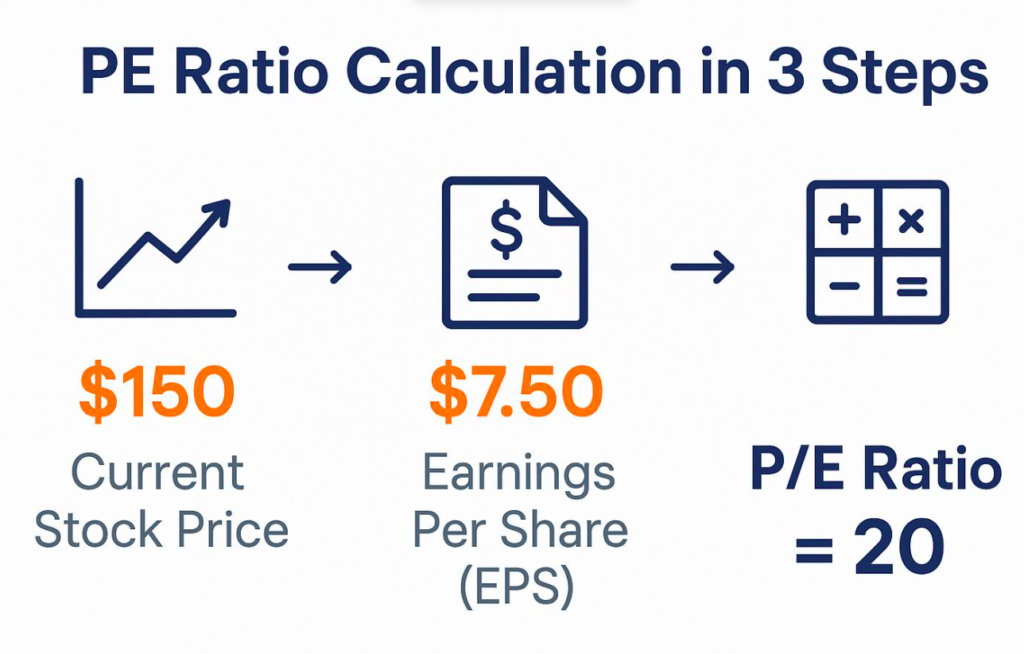
P/E Ratio Formula
P/E Ratio = Current Market Price per Share ÷ Earnings Per Share (EPS)
For example:
Suppose a company’s share price is ₹500 and its EPS is ₹25.
P/E Ratio = 500 ÷ 25 = 20
This means investors are paying ₹20 for every ₹1 of the company’s earnings per share.
What Is a Good P/E Ratio?
There is no universal good P/E ratio. It depends on the company’s industry, growth prospects, profitability and financial position.
- High P/E: May indicate strong growth expectations or an expensive valuation.
- Low P/E: May indicate an undervalued stock or weaker business prospects.
- Similar P/E: Compare companies with similar business models and growth characteristics.
Types of P/E Ratio
1. Trailing P/E Ratio
Trailing P/E uses the company’s actual earnings over the previous 12 months. It is based on historical financial performance.
2. Forward P/E Ratio
Forward P/E uses estimated earnings for the coming 12 months. It helps investors understand how the market values expected future earnings.
Advantages of P/E Ratio
- Easy to calculate and understand.
- Helps compare companies within the same industry.
- Provides insight into stock valuation.
- Helps investors understand market expectations.
- Supports fundamental stock analysis.
Limitations of P/E Ratio
- It does not guarantee future stock performance.
- It can be misleading when a company’s earnings fluctuate.
- It is generally not meaningful for loss-making companies.
- It does not consider debt independently.
- Different industries can have very different normal P/E ranges.
Conclusion
The P/E ratio is an important tool for understanding stock valuation. It helps investors determine how much they are paying for a company’s earnings.
However, investors should not make investment decisions using only the P/E ratio. Consider other financial metrics, including EPS growth, debt-to-equity ratio, ROE and cash flow, before making an investment decision.
Remember: A good company is not necessarily a good investment at every price.
Frequently Asked Questions (FAQs)
1. What does a P/E ratio of 20 mean?
It means investors are paying ₹20 for every ₹1 of the company’s annual earnings per share.
2. Is a high P/E ratio good or bad?
A high P/E may indicate strong growth expectations, but it can also indicate an expensive stock valuation.
3. Is a low P/E ratio good for investors?
Not always. A low P/E can indicate undervaluation or potential business problems.
4. How is P/E ratio calculated?
Divide the current market price per share by earnings per share (EPS).
5. Can P/E ratio be negative?
Yes. When a company reports negative earnings, the P/E ratio becomes negative or is generally considered not meaningful.