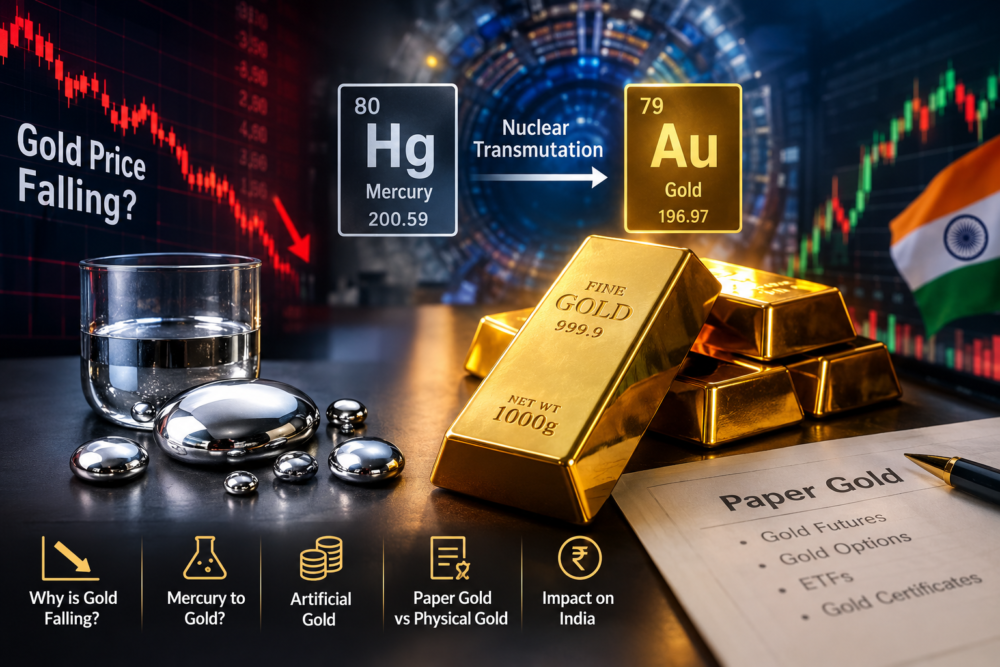
Gold has been considered one of the world’s most valuable metals for thousands of years. Investors buy gold as a store of value, central banks hold gold reserves, and millions of people in India purchase gold jewellery, coins and bars.Can Mercury Be Turned Into Gold? The Truth About Artificial Gold and Paper Gold
But gold prices do not always rise. They can fall sharply because of changing economic conditions, investor behaviour and movements in global financial markets.
At the same time, an interesting scientific question attracts attention: Can scientists create gold from mercury? Could artificial gold production eventually affect gold prices? And does paper gold have any role in the way the gold market operates?
In this article, we explore the reasons behind falling gold prices, the science of mercury-to-gold conversion, the difference between artificial and natural gold, and the possible implications for gold investors in India.Can Mercury Be Turned Into Gold? The Truth About Artificial Gold and Paper Gold tradecol
1. Why Is Gold Price Falling?
Gold prices fluctuate because of changes in supply, demand, economic expectations and financial-market activity. A falling gold price does not necessarily mean that gold has lost its long-term value.
Here are some important factors that can put downward pressure on gold prices.
A Strong US Dollar
International gold is generally priced in US dollars. When the dollar strengthens, gold can become more expensive for buyers using other currencies, potentially reducing demand.
A stronger dollar can therefore put downward pressure on gold prices, although the relationship is not always consistent.
Higher Interest Rates and Bond Yields
Gold does not generate interest or dividends. When interest rates or bond yields rise, some investors may prefer interest-bearing investments instead of gold.
Expectations about future interest-rate decisions can influence gold prices even before central banks change their rates.
Profit-Booking by Investors
When gold prices rise significantly, some investors sell their holdings to secure profits. If many investors sell around the same time, the resulting pressure can contribute to a price correction.
Changes in Global Demand
Gold demand comes from jewellery buyers, investors, central banks and industries. Changes in these sources of demand can influence prices.
Geopolitical uncertainty can support gold demand, while improved risk appetite or changing economic expectations can sometimes reduce demand for safe-haven assets.
Currency Movements and Gold Prices in India
Indian gold prices depend not only on international gold prices but also on the rupee-dollar exchange rate, import costs, applicable duties and taxes, and local market premiums.
For example, if international gold prices decline but the Indian rupee weakens against the US dollar, the decline in domestic gold prices may be smaller than expected.
Important: To explain why gold is falling on a particular day, check current international gold prices, the US dollar, bond yields, the rupee-dollar exchange rate and relevant market news. General explanations alone cannot establish the exact cause of a current price movement.
2. Can Mercury Be Turned Into Gold?
Yes, in principle. Scientists can transform one chemical element into another through a process called nuclear transmutation.
Mercury and gold are different chemical elements:
- Mercury (Hg) has 80 protons in its atomic nucleus.
- Gold (Au) has 79 protons in its atomic nucleus. download
To convert mercury into gold, a suitable nuclear reaction must change the number of protons in the nucleus and produce a gold isotope.
Ordinary chemical reactions cannot achieve this because chemical reactions rearrange electrons and chemical bonds without changing an element’s proton count.
Nuclear transmutation requires specialised scientific methods and equipment. It is not a simple chemical process that can be performed by mixing mercury with other substances.
3. Has Artificial Gold Ever Been Created?
Yes. Scientists have demonstrated that nuclear reactions can transform one element into another.
Researchers at CERN have reported the production of gold nuclei from lead nuclei during high-energy particle collisions. However, the quantities produced are extremely small and are not commercially useful supplies of gold bullion.
The distinction is important: proving that gold atoms can be created in a laboratory does not mean that gold can be manufactured economically on a large scale.
Any newer claims about commercial gold production through nuclear fusion or other technologies should be evaluated using independently verified experimental results, production quantities, energy requirements and estimated costs.
4. What Is Artificial Gold?
The term artificial gold can refer to different things, so it is important to understand the distinction.
Nuclear-Transmuted Gold
This is actual gold created by transforming atomic nuclei. If the resulting material consists of gold atoms, its chemical identity is gold regardless of how it was produced.
However, producing it economically remains a major challenge.
Imitation or Gold-Plated Products
Some products are made from other materials that look like gold. Gold-plated objects contain a surface layer of gold over another material, while imitation gold may contain no gold at all.
These products are not equivalent to pure gold bullion.
Gold-Backed Financial Products
Some investment products provide exposure to gold prices or are backed by physical gold under specific arrangements. These products should not be confused with artificial gold created through nuclear reactions.
Understanding these differences helps prevent misleading claims about the gold market.
5. What Is Paper Gold?
Paper gold is a general term for financial instruments that provide exposure to gold prices without necessarily requiring an investor to own physical gold directly.
Examples include gold futures, gold options and certain exchange-traded products.
These instruments allow traders and investors to participate in gold markets without buying and storing physical bars or coins.
Paper gold can be useful for hedging, speculation and investment, but different products have different risks, settlement rules and ownership arrangements.
For example, holding a gold futures contract is not the same as owning a gold bar in a personal safe.
6. Can Paper Gold Affect the Price of Physical Gold?
Yes. Gold futures and other financial instruments contribute to price discovery and can influence short-term gold-price movements.
Traders react to interest rates, economic data, currency movements and expectations about future demand and supply. Large buying or selling activity can affect market prices.
However, paper gold does not automatically mean that gold prices are artificially controlled.
Claims of deliberate price manipulation require credible evidence, such as documented misconduct or findings from relevant investigations. The existence of derivatives markets alone does not establish manipulation.
Physical supply and demand, investor sentiment, monetary policy and financial-market activity can all interact to influence gold prices.
7. Could Artificial Gold Make Gold Cheaper?
This is one of the most interesting questions in the discussion about artificial gold.
If scientists could produce large quantities of pure gold at a cost lower than the cost of obtaining it through mining and processing, artificial production could potentially affect gold supply and prices.
However, this would require more than proving that a nuclear reaction can produce gold atoms.
Commercial production would need to overcome several challenges:
- High equipment and capital costs.
- Energy and processing requirements.
- Efficient production at meaningful scale.
- Separation and purification of the resulting material.
- Reliable verification of purity and economic feasibility.
At present, nuclear transmutation is not an established economical replacement for gold mining.
Therefore, it would be misleading to claim that artificial gold production is already responsible for falling gold prices without reliable evidence demonstrating a connection.
8. Could Artificial Gold Production Affect Gold Prices in India?
India is one of the world’s major gold-consuming markets, particularly for jewellery and investment.
Indian gold prices are influenced by international bullion prices, the rupee-dollar exchange rate, import costs, applicable taxes and duties, and domestic demand.
If artificial gold ever became commercially viable and significantly increased global gold supply, it could theoretically affect international prices and, in turn, Indian gold prices.
But this is a hypothetical future scenario, not evidence of a current market impact.
For Indian buyers, it is more useful to monitor actual gold-price movements, currency changes, policy announcements and verified developments in gold production than to rely on speculation about artificial gold.
9. Is Gold Still a Good Investment?
Gold may play a role in diversification and wealth preservation, but it is not a risk-free investment.
Gold prices can fall, sometimes significantly, and investors may experience losses if they buy at high prices and sell during a downturn.
Before investing, consider your financial goals, investment horizon, liquidity needs, transaction costs and ability to tolerate price fluctuations.
Physical jewellery also involves making charges and other costs that can affect resale value. Financial products linked to gold have their own fees, risks and terms.
No investment decision should rely solely on a prediction that gold prices will rise or fall.
Conclusion: What Is Really Happening in the Gold Market?
Gold prices are shaped by several interconnected forces, including interest rates, currency movements, investment demand, physical supply and financial-market trading.
Nuclear science has demonstrated that gold atoms can be produced through transmutation, and paper-gold markets influence how gold is traded and priced. However, neither fact proves that artificial gold is currently causing a fall in gold prices.
The most reliable way to understand the gold market is to separate scientific possibilities from commercial realities and verified market evidence from speculation.
Before making investment decisions, check current market data, understand the risks and avoid relying on sensational claims alone.