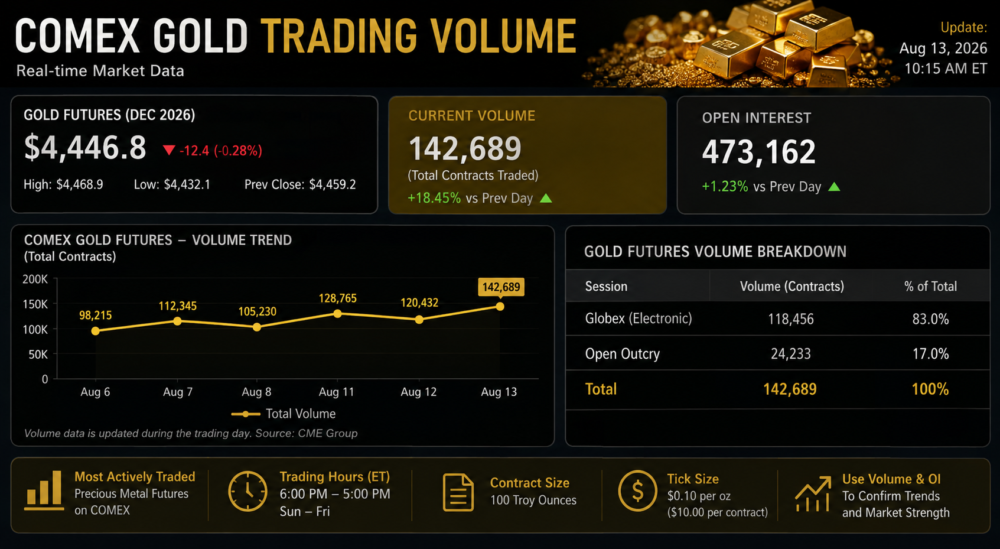
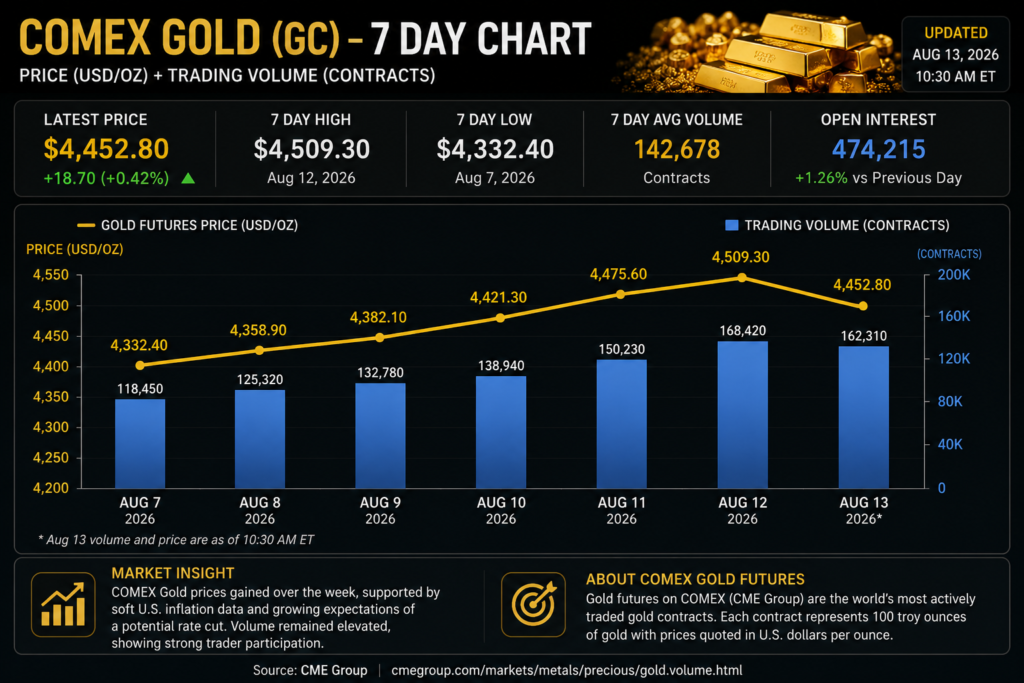
COMEX gold remains one of the world’s most actively followed precious-metals futures markets, with trading activity closely monitored by investors, traders, and institutions. CME Group provides daily Gold Futures volume and open-interest data covering Globex and other trading channels.COMEX Gold Trading Volume Today: Latest Market Activity and Gold Price Update
As of August 13, 2026, gold prices remain highly sensitive to U.S. economic data, Federal Reserve interest-rate expectations, inflation, and geopolitical developments.
The latest market session saw gold prices fluctuate after the release of U.S. Producer Price Index (PPI) data. Spot gold traded around $4,386.69 per ounce, while U.S. gold futures fell toward $4,444 per ounce before recovering from session lows.
Why COMEX Gold Trading Volume Matters
Trading volume measures the number of futures contracts traded during a particular period. Higher volume generally indicates stronger market participation and liquidity.
For gold traders, volume can help confirm whether a price move has strong market participation behind it.tradecol
For example:
- Price rising + high volume: bullish move may have stronger participation.
- Price falling + high volume: selling pressure may be significant.
- Price rising + low volume: the move may have weaker confirmation.
- Price falling + low volume: selling pressure may be less convincing.
However, volume should not be used alone to predict the next move in gold.
COMEX Gold Volume vs Open Interest
Trading volume and open interest are different metrics.
Trading volume measures how many contracts change hands during a trading session.
Open interest measures the number of outstanding futures contracts that remain open.
Combining price, volume, and open interest can provide a better picture of market participation and positioning.
What Is Driving Gold Prices Today?
Several factors are currently influencing gold:
1. Federal Reserve Interest-Rate Expectations
Interest-rate expectations remain one of the most important drivers of gold. Lower expected rates can support gold because the opportunity cost of holding a non-yielding asset decreases.
Recent U.S. inflation and PPI data have reduced some expectations for an immediate rate increase, supporting gold prices.
2. U.S. Inflation Data
U.S. July CPI showed inflation rising 3.4% year over year, while the latest PPI reading showed producer prices unchanged in July. These releases have contributed to volatility in gold futures.
3. $4,500 Gold Price Level
The $4,500 per ounce area is an important psychological level for traders. Recent price action has shown resistance around this region, making it a level worth monitoring for potential breakouts or reversals.
How to Track COMEX Gold Trading Volume
Traders can monitor official Gold Futures volume and open-interest data through CME Group’s market-data pages. CME provides volume information for Gold Futures as well as historical and daily exchange reports.
Important: Intraday volume changes continuously during the trading session, so the final daily volume should be checked after the session or directly through the latest CME data.
COMEX Gold Trading Volume: Key Takeaway
COMEX gold trading volume is an important indicator of market participation and liquidity. When analyzed together with price action and open interest, volume can help traders understand whether a move in gold has meaningful participation behind it.
With gold currently reacting to U.S. inflation data and Federal Reserve expectations, traders should closely monitor COMEX gold volume, open interest, the $4,500 resistance zone, U.S. economic data, and Fed policy expectations.