The Indian stock market is influenced by several participants, including retail investors, domestic institutional investors (DIIs), and foreign institutional investors (FIIs).Why Are FIIs Net Buyers in the Indian Stock Market?
Whenever FIIs become net buyers in the Indian stock market, investors pay close attention because their buying and selling activities can influence market sentiment, liquidity, and stock prices.
But an important question arises: Where does FII money actually come from, and why are foreign investors investing in India?
Let’s understand everything step by step.
1. What Are FIIs?
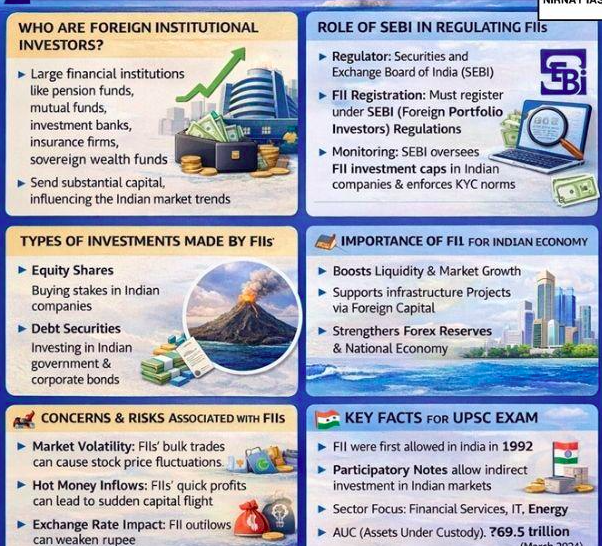
FII stands for Foreign Institutional Investors. These are large financial institutions or investment funds based outside India that invest in Indian financial markets.
They invest money in various financial instruments, including:
- Equity shares
- Government bonds
- Corporate bonds
- Index futures and options
- Other permitted financial instruments
Today, foreign portfolio investors (FPIs) is the commonly used regulatory terminology in India.
Examples of foreign institutional investors include international mutual funds, pension funds, insurance companies, hedge funds, and sovereign wealth funds.Why Are FIIs Net Buyers in the Indian Stock Market?
2. Where Does FII Money Come From?
One of the most interesting aspects of foreign investment is that the money does not necessarily belong to the institution itself.
These institutions collect and manage money from different sources across the world.
The major sources include:
A. Pension Funds
Pension funds collect retirement contributions from employees and employers.
These funds invest in different countries and financial markets to generate long-term returns.
For example, a US pension fund may allocate a portion of its investment portfolio to Indian companies.
B. Mutual Funds
International mutual funds collect money from thousands or millions of investors.
Their fund managers invest this pooled money in different markets, including India.
C. Insurance Companies
Insurance companies collect premiums from policyholders.
A portion of these funds is invested in financial markets to generate returns and meet future obligations.
D. Hedge Funds
Hedge funds collect capital from eligible investors and institutions.
They often use advanced investment strategies to identify opportunities in different markets.
E. Sovereign Wealth Funds
Sovereign wealth funds are government-owned investment funds.
They invest national wealth in international financial markets, companies, infrastructure, and other assets.
F. Exchange-Traded Funds (ETFs)
Global ETFs collect money from investors and track specific market indices or investment strategies.
For example, an international ETF tracking Indian equities may invest in companies listed on Indian stock exchanges.
3. Why Are FIIs Investing in the Indian Stock Market?
Foreign investors consider several factors before investing in India.
1. Strong Economic Growth
India is one of the major emerging economies. Expectations of economic growth can attract international investors.
2. Corporate Earnings Growth
When Indian companies report strong revenue and profit growth, foreign investors may become interested in purchasing their shares.
3. Attractive Stock Valuations
When stock prices correct, some companies may become more attractive compared with their historical valuations or international alternatives.
4. Global Investment Diversification
International investors do not want to invest all their money in one country.
They diversify their portfolios across different economies to manage risk.
5. Currency and Interest Rate Factors
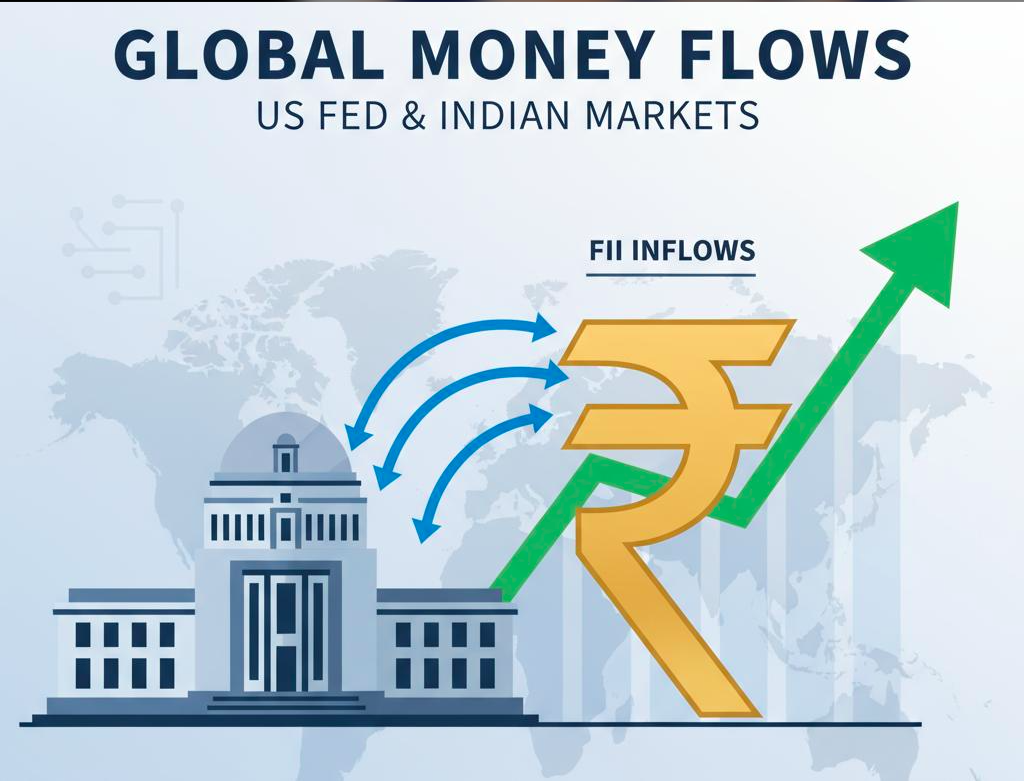
Changes in the US Federal Reserve’s interest rates, US bond yields, and the Indian rupee can influence foreign investment decisions.
6. Global Market Opportunities
If investors find better opportunities in emerging markets, they may shift some capital from developed markets to countries such as India.
4. What Does FII Net Buying Mean?
FII net buying means foreign institutional investors purchased more shares than they sold during a particular period.
Let’s understand with an example.
| Particulars | Amount |
|---|---|
| Total FII purchases | ₹10,000 crore |
| Total FII sales | ₹4,000 crore |
| Net FII buying | ₹6,000 crore |
Formula:
FII Net Buying = Total Purchases − Total Sales
Therefore:
₹10,000 crore − ₹4,000 crore = ₹6,000 crore.
This means FIIs are net buyers by ₹6,000 crore.
It does not necessarily mean that the entire ₹6,000 crore represents newly introduced foreign capital. It is the net difference between purchases and sales.
5. Why Are FIIs Net Buyers in the Indian Stock Market?
FII activity can influence the Indian stock market because foreign institutions manage substantial amounts of capital.
When FIIs purchase large quantities of shares, buying demand can increase and potentially support stock prices.
For example:
- Heavy FII buying in banking stocks can support Bank Nifty.
- Buying in large-cap IT companies can influence the Nifty index.
- Broad-based FII buying can improve overall market sentiment.
However, FII buying does not guarantee that the market will move upward.
Other factors, such as domestic institutional activity, global market movements, economic news, and derivatives positioning, also influence the market.
6. FII Cash Market vs FII Futures Market and Why Are FIIs Net Buyers in the Indian Stock Market?
It is important to understand the difference between cash market activity and derivatives activity.
FII Cash Market:
FIIs purchase or sell actual shares of listed companies.
FII Futures Market:
FIIs take long or short positions in index or stock futures.
For example:
- An FII taking a long position in Nifty futures indicates bullish futures exposure.
- An FII taking a short position in Nifty futures indicates bearish futures exposure.
However, futures positions can also be used for hedging. Therefore, they should not be interpreted as pure bullish or bearish bets without considering the overall portfolio.
7. How Can Retail Traders Track FII Activity?
Retail traders can monitor institutional activity using publicly available market data.
Some useful sources include:
- NSE India – Institutional trading activity.
- NSDL – Foreign portfolio investor investment data.
- CDSL – Depository-related market information.
- Moneycontrol – Market data and institutional activity.
- Stock exchange reports – Derivatives and open-interest information.
Traders should monitor:
- FII cash market buying and selling.
- DII cash market buying and selling.
- FII index futures long and short positions.
- Changes in open interest.
- Nifty and Bank Nifty price action.
- Global market movements.
- Why Are FIIs Net Buyers in the Indian Stock Market?
8. Can We Predict the Market Using FII Data?
FII data is useful for understanding institutional activity, but it should not be used as the only indicator for predicting market direction.
Consider these scenarios:
| FII Activity | Possible Market Interpretation |
|---|---|
| FII buying + DII buying | Strong institutional demand |
| FII selling + DII buying | Domestic investors absorbing selling |
| FII buying + Nifty falling | Other selling pressure may be dominating |
| FII selling + Nifty rising | Domestic buying may be supporting the market |
For intraday traders, combining FII data with price action, volume, support and resistance, and option-chain analysis can provide better context.
Conclusion
Foreign institutional investors play an important role in the Indian stock market.
Their investment capital comes from different sources, including pension funds, mutual funds, insurance companies, hedge funds, sovereign wealth funds, and ETFs.
FIIs invest in India because they identify opportunities for returns, diversification, economic growth, and attractive valuations.Why Are FIIs Net Buyers in the Indian Stock Market?
Understanding FII buying and selling can help investors develop a better understanding of institutional money flow and overall market sentiment.
However, remember that institutional buying is not a guarantee of market growth. Always consider multiple indicators before making an investment decision.